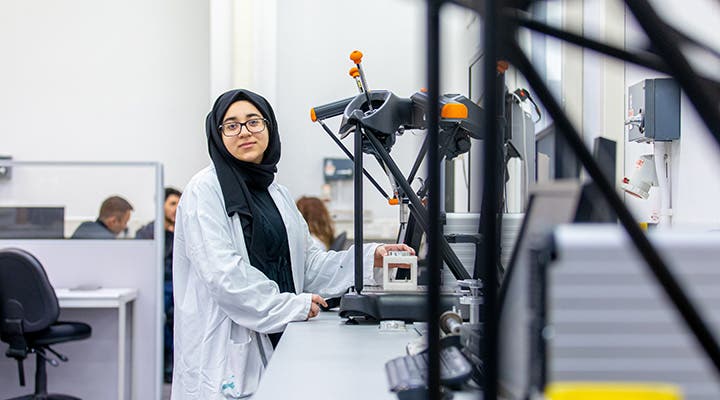
Engineering student in lab

International Foundation Year in Engineering, Science and Computing

The International Foundation Year prepares you for university with English language and study skills practice, as well as subject-specific teaching. When you complete the programme, you will progress to the first year of your undergraduate degree. Learn more about how humans can work in harmony with the natural world and choose to progress to a degree in architecture, environmental geography, computing or an engineering subject.

Key facts

*This intake is not available for progression to Optometry, Dental Surgery, Medicine, Medical Pharmacology or Pharmacy

  • Length: Two semesters
  • Study mode: On campus

Entry requirements

Check our academic and English language entry requirements

Fees

Visit the Fees page for full details.

Your pathway to Cardiff University

Cardiff University International Study Centre puts you on the path to an exciting future. Our International Foundation Year develops your subject knowledge and English language skills, ready for your undergraduate degree. Progress to a respected Russell Group university. Degree programmes are enhanced by industrial collaboration, giving you the skills, experience and contacts to achieve your career goals.

What will I study?

As a student on the this pathway of the International Foundation Year, you will study core modules as well as elective modules that are assigned depending on your chosen degree.

Core modules

Academic English Skills aims to provide thorough training in the language and related academic skills which will enable international students to best achieve their academic potential at the partner University.

The Statistics with Project Skills module aims to develop students’ statistical competence in Semester 1 and to apply research, collaborative, and investigative skills in Semester 2 through a structured sustainability-focused project. The module integrates quantitative reasoning with authentic project-based inquiry to prepare students for undergraduate study.

The module is divided into two integrated phases. In Phase 1, students develop core statistical knowledge and techniques through structured disciplinary problem-solving. In Phase 2, students will engage in an investigative project, collaborating, if possible, within multidisciplinary teams to explore and resolve sustainability challenges. This phase builds directly on the subject knowledge and analytical skills developed in Semester 1.

The module is designed to provide a strong foundation in mathematical modelling and core mathematics skills required for courses in Engineering, Computing, Economics & Finance and other STEM subjects. Its overall aim is to develop the academic language, subject-specific knowledge, academic study skills, and cultural awareness of international students from a wide range of countries and educational systems. This will enable them to progress confidently onto their chosen undergraduate programme with the appropriate subject background skills. The module also aims to foster an interest in mathematics and its applications, while enhancing students' self-confidence, initiative-taking, and independent working skills.

Elective modules

This module introduces the essential principles and concepts of computer science to students with diverse backgrounds, aiming to prepare them for further undergraduate studies in this field. By engaging with this module, students will cultivate their computational thinking abilities, which will enable them to approach real-world systems and their own creations with creative, analytical, and logical perspectives. Moreover, students will acquire foundational programming skills and will create a programme, applying the principles, techniques, and methodologies learned throughout the module in a practical context.

The chemistry module is a comprehensive course that establishes a strong foundation in chemistry principles. The module covers fundamental topics in atomic structure, chemical bonding, reactions, and thermodynamics. Through analysis of theoretical models, case studies, and quantitative data, students gain a deep understanding of chemistry.

This module is a cornerstone for students' future studies in chemistry, as it provides them with the analytical and problem-solving skills and knowledge necessary to succeed in both academic and professional settings. Chemists are in high demand in a variety of fields, including medicine, materials science, and environmental science. The Chemistry Module equips students with the skills they need to contribute to these and other important fields.  

The Physics module provides international students with a comprehensive introduction to the fundamental concepts of physics. Through a combination of seminars, experiments, and discussions, students will gain a deep understanding of physics and develop the skills they need to succeed in further study and careers in science and engineering. Topics covered include waves, materials, mechanics, fluids, electrical circuits, and atomic physics. Students will learn about the fundamental laws of physics and how these can be applied to the real-world scenarios. Students also enhance their English language skills through academic writing and discussions. This module prepares international students for further studies and careers in science and engineering.

High student satisfaction

100% of students on both MMath Mathematics and BSc Mathematics, Operational Research and Statistics with a Placement Year were satisfied with their course.

Source: most recent National Student Survey

Top 50

in the world for Architecture.

QS World University Rankings by Subject 2026

Progress to your degree

After completing your International Foundation Year and achieving the necessary grades, you can transition to your chosen undergraduate degree.

Degree Programme NameAwardOverall GradeEnglish GradeGrade Module
No Results

Please note that for students wishing to progress to Architecture

All students with a progression degree of BSc (Hons) Architecture receive support with their Design Portfolio in addition to targeted support with academic subjects when necessary. Portfolio support is delivered on a weekly basis by experienced staff from the Welsh School of Architecture and will enable students to develop and expand their drafting skills, use of media, and engagement with the subject. Students are also guided through the process of creating their portfolio and selecting the best pieces to include to support their progression.

The Architecture School will review the Design Portfolio in addition to the grades listed. You must pass this portfolio in order to be offered a place on Architectural Studies. If you are unsuccessful in your portfolio the ISC will support you with alternative options.


Join us today

We're here to support you throughout the application process. Use our online application form and our student enrolment advisors will be available to answer your questions.